
Wailing Widow Falls, Scotland: How to Visit One of Assynt’s Most Dramatic Waterfalls
Wailing Widow Falls
Wailing Widow Falls is one of those Highland places that feels far bigger than its size on the map. Hidden beside Loch na Gainmhich in Assynt, Sutherland, the waterfall spills from the loch and drops into a steep rocky gorge, surrounded by rugged cliffs, mountain views and the wild open scenery that makes this corner of north-west Scotland so unforgettable.
Hotels near Wailing Widow Falls | Click Here
The falls are often visited by people travelling the North Coast 500 or exploring the road between Loch Assynt and Kylesku. They are not a polished tourist attraction with big signs, paved paths and facilities. That is part of the appeal. Wailing Widow Falls still has a raw, natural feel.
Where is Wailing Widow Falls?

Smidge That Midge
Insect Repellant - This will keep the little blighters at bay - see the reviews.
Get Yours Today »Wailing Widow Falls is located beside the A894, close to Loch na Gainmhich, between Loch Assynt and Kylesku Bridge. The nearest small settlement is Unapool, with Kylesku just a short drive away.
The waterfall is sometimes referred to as Loch na Gainmhich Waterfall, as it is fed by the loch above. The water drops from the loch’s outflow into a narrow gorge.
How to get there by car
Most visitors arrive by car, as this is a remote Highland location with no major public transport stop at the falls themselves. If you are driving north from Ullapool or Loch Assynt, follow the A837 and then the A894 towards Kylesku. The road passes through spectacular Assynt scenery before reaching Loch na Gainmhich and the parking areas near the waterfall.
If you are coming from Kylesku, head south on the A894. After only a few minutes, the road climbs and bends around the area above Loch na Gainmhich. The parking areas are small and easy to miss if you are not looking for them, so it is worth slowing down carefully as you approach the loch geomagnetic anomaly area.
This is not a place with a big brown tourist sign and a visitor centre. Use your map or sat nav to find Loch na Gainmhich, Wailing Widow Falls or Quinag Viewpoint, then look for safe roadside parking areas on the A894. Take care when pulling in or out, as the road can be busy with NC500 traffic, campervans and motorhomes during the main season.
Parking for Wailing Widow Falls
There are two main parking options depending on which view you want: the lower roadside lay-by for the gorge path, or the upper parking area associated with the Quinag Viewpoint for the high-level view.
The lower parking area is the most useful if you want to walk to the base of Wailing Widow Falls. This is a small roadside lay-by close to the start of the rough gorge path. Space is limited, and at busy times it may only take a few cars before it feels full. Do not block the road, passing places, gates or access points. If there is no safe room, continue to another pull-in rather than squeezing in.
The upper parking area, often associated with the Quinag Viewpoint or Loch na Gainmhich area, is better for seeing the falls from above. This gives access to the lochside and the high-level view where the waterfall drops away from Loch na Gainmhich into the gorge below. This parking is still limited, but it can be more obvious than the lower lay-by and is often the better option for larger vehicles.
There are no toilets, cafés or visitor facilities at the falls, so plan ahead. Kylesku, Lochinver and Ullapool are better places to look for food, toilets, fuel and accommodation.
Walking to the base of the falls
The walk to the base of Wailing Widow Falls is short, but it should not be treated like a simple pavement stroll. From the lower roadside parking area, the rough path follows the burn upstream into the gorge. The walk usually takes around 10 to 20 minutes each way depending on conditions, how confident you are on uneven ground, and how often you stop for photographs.
The route is not a formal surfaced trail. Expect mud, wet grass, rocks, roots and short scrambly sections. After rain, the ground can be very slippery, especially on the rocks near the water. Good walking shoes or boots with proper grip are strongly recommended. Trainers with smooth soles are not ideal here.
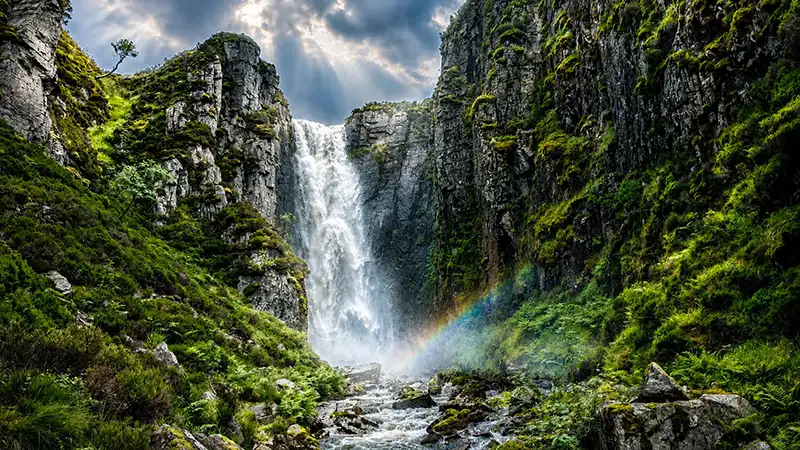
As you walk into the gorge, the cliffs begin to close in and the sound of the waterfall grows stronger. The view from the bottom is dramatic: water plunging down between dark rock walls, spray rising from the base, and the stream tumbling away through stones and boulders. It is a fantastic place for photography, particularly after rain when the waterfall is fuller, though you should always keep a sensible distance from wet rocks and fast-moving water.
For many visitors, this lower route is the most atmospheric way to experience Wailing Widow Falls. You feel the scale of the gorge, hear the water echoing off the rock, and get a real sense of being tucked inside the landscape rather than simply looking across it.
Walking to the upper viewpoint
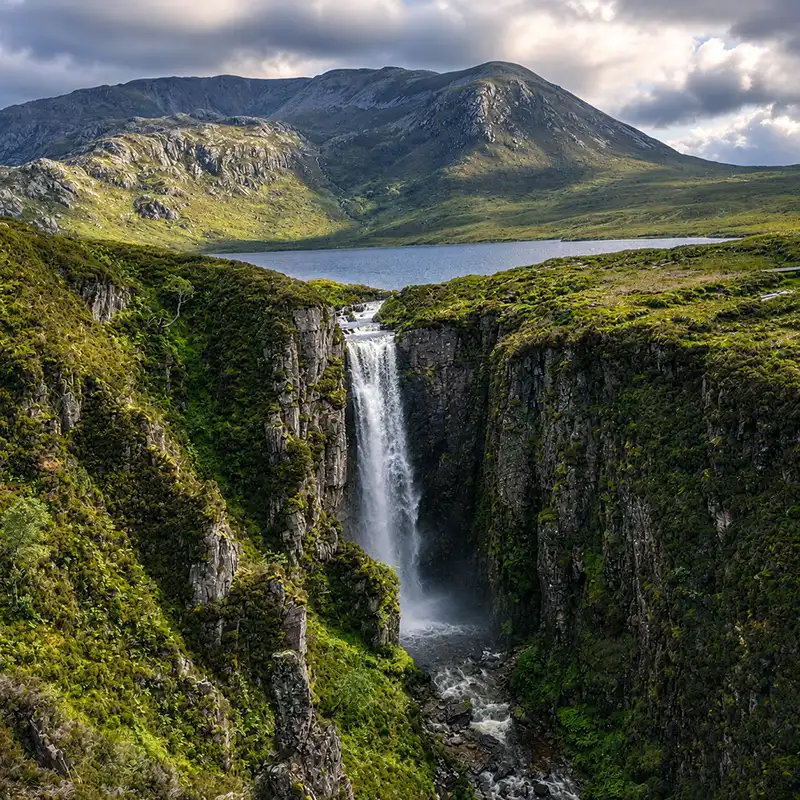
The upper viewpoint gives a completely different impression of the falls. From the upper parking area near Loch na Gainmhich, you can walk over rough, often boggy ground towards the loch and the waterfall outflow. This is the view many people recognise from photographs: the waterfall dropping into the gorge, with the loch behind it and mountains rising beyond.
The upper route can be easier in terms of distance, but the ground may be very wet and uneven. In places it can feel more like crossing moorland than following a path. Waterproof boots are useful, and after heavy rain you should expect boggy patches.
Take particular care near the top of the gorge. There are no barriers, and the edge can be dangerous. The best view is not worth stepping too close. Stay well back from the drop, especially in wind, rain or poor visibility. Children and dogs should be kept under close control.
For photography, the upper viewpoint is often the most spectacular. It captures the full Highland setting: Loch na Gainmhich feeding the falls, the gorge cutting through the rock, and the Assynt hills forming a dramatic background. On a day with broken cloud and shafts of sunlight, the scene can be extraordinary.
How difficult is the walk?
Wailing Widow Falls is a short visit, but the difficulty depends on which route you choose and what the weather has been doing.
The lower gorge route is short but rough. It is best for people who are comfortable walking on uneven, muddy and rocky ground. In dry conditions it may feel fairly manageable for regular walkers, but in wet weather it becomes much more slippery.
The upper viewpoint route is also short, but it can be boggy and exposed. It is not technically difficult if you stay away from the cliff edge, but it does require care, especially when the ground is saturated.
Overall, this is a place for sturdy footwear, sensible judgement and a bit of Highland caution. You do not need to be a serious hillwalker to enjoy the falls, but you should not expect a maintained tourist path either.
Best time to visit
Wailing Widow Falls can be visited year-round, but conditions vary greatly. Spring and autumn are often excellent, with good water flow, dramatic skies and fewer midges than summer. Summer brings longer daylight hours and easier driving conditions, but it can also mean more traffic and limited parking. After heavy rain, the waterfall is usually more powerful, though the paths will also be muddier and more slippery.
For photography, a bright overcast day can work well at the base of the falls, as harsh sun can make the contrast difficult inside the gorge. For the upper viewpoint, broken cloud and low-angle light can create beautiful shadows across the loch and mountains.
What to bring
Wear walking boots or sturdy shoes with good grip. A waterproof jacket is sensible even if the forecast looks fair, as the weather in Assynt can change quickly. A camera or phone is a must, but keep it secure near the water and cliff edges. In summer, midge repellent can make the visit much more comfortable.
There are no bins, so take all litter away with you. The area feels wild and unspoilt because people look after it, and it is important to leave it that way.
Nearby places to visit
Wailing Widow Falls is easy to combine with other Assynt highlights. Kylesku Bridge is just to the north and offers one of the most recognisable road views in the Highlands. Ardvreck Castle, on the shore of Loch Assynt, is a beautiful stop for history and photography. The Bone Caves near Inchnadamph make a rewarding walk, while Lochinver and Achmelvich are worth visiting if you are heading west towards the coast.
If you are using the falls as part of a longer Highland break, this area rewards slow travel. The roads are scenic, the views change constantly, and even short stops can become memorable.
Final thoughts
Wailing Widow Falls is not a long walk or a major organised attraction, but that is exactly what makes it special. It offers a concentrated dose of Highland drama: a hidden waterfall, a rocky gorge, a lonely loch, mountain views and the feeling of being somewhere genuinely wild.
Go prepared, park responsibly, wear proper footwear and take your time. Whether you walk into the gorge to stand below the falling water or head up to the lochside for the classic view from above, Wailing Widow Falls is one of Assynt’s most rewarding short stops.